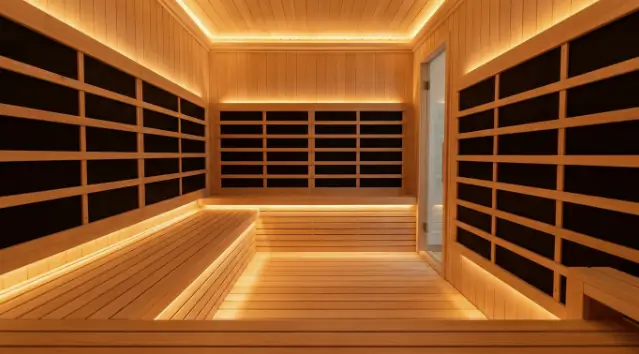
Most one- and two-person infrared cabins plug into a standard 120-volt household outlet on a dedicated circuit rated for at least 15 amps. Once a cabin grows to four or five seats, or adds a full-spectrum heater with extra panel banks, total wattage typically climbs past what a 120-volt line can carry, and a dedicated 240-volt circuit stops being optional. The number that actually matters is total wattage, not seat count, since two cabins marketed at the same size can draw very different amounts of power. Checking that number before ordering, not after a crate shows up on the driveway, is the step that saves beginners the most trouble.
Why Wattage, Not Size, Decides the Question
Shoppers new to infrared often assume voltage scales cleanly with cabin size, and it mostly does, but the real driver is how many heating panels are packed into the walls and how much each one draws. A compact one-person pod with three panels might pull 1,200 watts total. A five-person cabin with eight or more panels, or a full-spectrum unit that layers near, mid, and far infrared elements, can push past 3,000 watts. Two cabins that look similar in a product photo can sit on opposite sides of the 120-volt line, which is why the spec sheet matters more than the marketing copy.
What a 120-Volt Circuit Can Actually Carry
A standard 15-amp, 120-volt household circuit supplies roughly 1,800 watts of theoretical capacity, but electricians plan around 80 percent of that for anything running continuously, which puts the practical ceiling closer to 1,440 watts. A 20-amp circuit raises that working ceiling to around 1,920 watts under the same math. Most compact one- and two-person infrared cabins with three or four panels fall comfortably inside either number, which is exactly why they ship with a standard household plug instead of a hardwired connection.
When 240 Volts Stops Being a Choice
Four-person and larger cabins, along with most full-spectrum models built for a stronger dose per session, commonly draw 2,400 to 3,600 watts. That is well past what a 120-volt circuit can supply under any reasonable safety margin, and no manufacturer will rate a unit that size for a standard outlet. At that wattage, the cabin needs its own 240-volt run from the panel, sized to the amperage the manufacturer specifies, ending in either a NEMA-rated outlet or a direct hardwired connection depending on the model.
Read the Power Spec Before You Read the Price
A legitimate listing states voltage, amperage, and total wattage clearly, usually in a small chart next to interior dimensions. A description that only promises “simple plug-in setup” without numbers is missing the one detail a beginner actually needs. Retailers who sell across multiple cabin sizes, including a dedicated sauna retailer, tend to list this alongside pricing precisely because size and power draw move together, and comparing that line item across a few listings before deciding is worth more than comparing photos.
Budget the Electrician Alongside the Cabin
If a 240-volt line is not already run to the intended spot, that is a second line item beyond the sauna itself. Cost swings by region and by how far the install site sits from the panel, but a dedicated 240-volt circuit for a home appliance is common enough work that most residential electricians can quote it accurately after a quick look at the panel and the planned location. Getting that quote before ordering a larger cabin avoids the situation where a sauna sits boxed in a garage for weeks waiting on a contractor’s schedule.
A Short Checklist Before You Order
Before adding a cabin to the cart, a beginner should have answers to four questions: the total wattage listed on the spec sheet, whether that number fits inside 120 volts or requires 240, whether the panel has spare capacity for a new circuit if 240 volts is needed, and how far the planned sauna spot sits from the panel. A retailer or product page that cannot answer the first question directly is worth a follow-up message before ordering, not a guess made after delivery.
Why This Trips Up Beginners More With Infrared Than Traditional Saunas
Traditional sauna heaters are almost always 240 volts because they need to heat an entire room’s air past 170 degrees, so the wiring question rarely comes up as a decision point for that category. Infrared is the category where 120 volts is genuinely an option for smaller cabins, which is part of why it appeals to people converting a spare room or basement corner without wanting to open a wall for new wiring. That same flexibility is also why the size threshold catches people off guard: assuming every infrared cabin plugs into a normal outlet works fine until the day a beginner orders a larger unit and finds out otherwise at delivery.
Common Wiring Mistakes First-Time Buyers Make
The most frequent mistake is ordering a cabin before confirming the outlet or circuit situation, then discovering at delivery that the intended spot has no dedicated circuit at all, just a shared outlet already running a chest freezer or a window air conditioner. A close second is assuming an existing 240-volt outlet in a garage, often left over from an old dryer hookup, is automatically compatible, when the amperage, plug configuration, or breaker size may not match what the sauna manufacturer specifies. A third common error is skipping the permit step on a 240-volt run because the work seems minor, which can create problems later when selling a home or filing an insurance claim tied to electrical work that was never inspected.
Avoiding all three comes down to the same habit: treat the electrical question as step one of the purchase, not a detail to sort out after the cabin arrives. A short phone call to an electrician, describing the wattage from the spec sheet and the planned location, usually settles whether the existing setup works, needs modification, or needs a new circuit entirely, and that answer is worth having before checkout rather than after delivery.
Renting Versus Owning Changes the Calculation
Anyone renting rather than owning their home has an extra variable to weigh, since a new 240-volt circuit is a permanent modification to the property that a landlord may or may not approve. Beginners in a rental are often better served sticking to a cabin sized to run on 120 volts, since that setup can move with a tenant to the next apartment without leaving behind wiring work tied to the unit. Homeowners planning to stay put for years have more flexibility to invest in a larger cabin and the 240-volt line it needs, since the electrical upgrade adds to the property rather than being left behind.
Frequently Asked Questions
Will a small infrared sauna work on a regular wall outlet? Most one- and two-person cabins are built for a standard 120-volt, 15 or 20 amp outlet, provided the circuit is dedicated and not shared with anything else in the room. Check the listed wattage before assuming this applies to a specific model.
What total wattage pushes a cabin into 240V territory? Once total draw climbs past roughly 1,800 to 2,000 continuous watts, a standard 120-volt household circuit is no longer a safe or supported option. Most four- and five-person cabins, and many full-spectrum models, land above that line.
Can a beginner install a 240V sauna circuit themselves? No. Running a new 240-volt line means opening the electrical panel, sizing a breaker correctly, and in most areas pulling a permit, which is licensed-electrician work rather than a weekend project for someone without electrical training.
Does asking for 240V mean the sauna heats faster? Not by much for cabins of similar size. Warm-up time tracks panel count and wattage per panel more than voltage itself. What 240V buys is the ability to run more panels safely, which mostly matters for larger cabins.
References
- Clinical Effects of Regular Dry Sauna Bathing: A Systematic Review, Evidence-Based Complementary and Alternative Medicine, 2018
- Benefits and risks of sauna bathing, The American Journal of Medicine, 2001
- Cardiovascular and Other Health Benefits of Sauna Bathing: A Review of the Evidence, Mayo Clinic Proceedings, 2018
By Nathan Pierce